
Your credit score is one of the numbers lenders look at when determining what financing you qualify for—and, just as importantly, what that financing may cost you.
A stronger credit score can open the door to more loan options and better terms, while a lower score can mean higher rates, lower leverage, or additional requirements.
For real estate investors, understanding how credit score affects DSCR loans is especially important. Depending on the lender, your credit score can affect your interest rate, maximum loan-to-value (LTV), minimum debt-service coverage ratio (DSCR), and ultimately how much cash you need to bring to the table.
What Is a Credit Score?
A credit score is a three-digit number designed to help lenders assess your credit risk. It is based on information in your credit report and considers factors such as your payment history, credit utilization, length of credit history, and recent credit activity.
There are multiple credit scoring models, including FICO and VantageScore, and each uses its own methodology. In real estate finance, mortgage lenders often rely on a borrower’s FICO score when evaluating loan eligibility and terms.
How Is Your FICO Score Determined?
For the commonly used FICO scoring model, your score is generally calculated using five major categories:
-
- 35%: Payment history — Do you make your payments on time?
- This is the largest factor in your FICO score. Consistently making payments on time is one of the most important things you can do to maintain a strong credit profile.
- 30%: Amounts owed — How much of your available credit are you using?
- Lower credit utilization is generally better for your score. Keeping balances well below your available credit limits can help.
- 15%: Length of credit history — How long have your credit accounts been established?
- The age of your accounts can play a role in your score. Before closing an older account, consider how doing so could affect your overall credit profile.
- 10%: Credit mix — What types of credit accounts do you have?
- FICO considers the different types of credit you manage, such as credit cards, auto loans, and mortgages. However, this doesn’t mean you should take on debt simply to create a more diverse credit mix.
- 10%: New credit — Have you recently applied for credit?
- New credit applications can result in hard inquiries, which can affect your score. Hard inquiries can remain on your credit report for up to two years, although their impact on your score is generally much shorter-lived.
- 35%: Payment history — Do you make your payments on time?
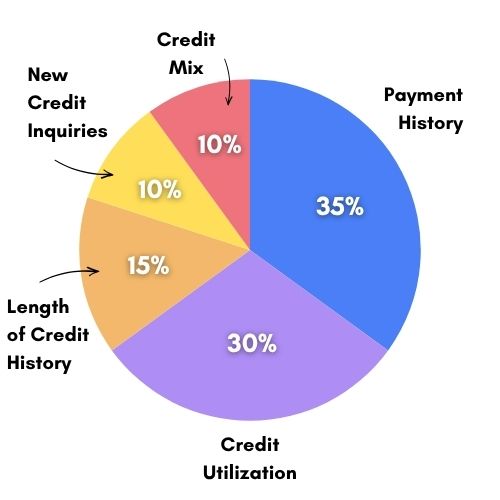
These percentages are general guidelines for the FICO scoring model. Your actual score is determined by the information in your credit profile, and the impact of any individual factor can vary from person to person.
How Your Credit Score Affects Loan Terms
From a lender’s perspective, your credit score is an indicator of how you have historically managed credit obligations. While it is only one part of the underwriting process, a stronger credit profile can signal lower perceived risk to the lender.
That can translate into better financing terms, such as a lower interest rate, higher leverage, or more flexible qualification requirements.
And this isn’t limited to conventional mortgages. Credit score plays a very meaningful role in DSCR financing as well.
How Credit Score Affects DSCR Loans
DSCR loans are primarily underwritten based on the cash flow of the investment property and the borrower’s credit score.
Here’s what this can look like in practice. One DSCR lender, for example, adjusts several loan terms based on the borrower’s FICO score:
Interest Rate
-
- 680–699 FICO: 6.80%
- 760+ FICO: 6.57%
In this example, the borrower with the higher credit score receives a lower interest rate.
The difference may look small, but even a modest change in interest rate can add up over the life of a loan.
Maximum Leverage
-
- Below 700 FICO: 75% LTV
- Above 700 FICO: 80% LTV
Here, the difference can be even more significant for an investor’s cash requirements.
Consider a $400,000 investment property:
-
- At 75% LTV, the maximum loan would be $300,000
- At 80% LTV, the maximum loan would be $320,000
That’s a $20,000 difference in the amount you could potentially borrow, meaning $20,000 less cash would be needed for the down payment, before considering closing costs and other expenses.
Minimum DSCR Requirement
-
- Below 720 FICO: 1.20x minimum DSCR
- Above 720 FICO: 1.10x minimum DSCR
This is another important distinction.
A lower DSCR requirement means the property can produce less cash flow relative to its debt obligations and still meet the lender’s requirement. In other words, a higher-credit borrower may be able to qualify for financing on a property that wouldn’t meet the same lender’s requirements for a lower-credit borrower.
This illustrates why your credit score isn’t simply about getting approved or denied. It can influence the actual structure of your loan.
General Credit Score Benchmarks for DSCR Loans
Every lender evaluates and underwrites DSCR loans differently. Minimum credit scores, interest rates, LTV limits, and DSCR requirements can all vary from one lender to another.
Still, having some general benchmarks can be helpful when you’re evaluating your financing options.
As broad generalizations:
-
- 660+: Common starting point for minimum FICO requirements
- 700+: Often where higher leverage becomes available
- 760+: Often associated with the strongest pricing
These aren’t industry-wide rules. Individual lenders may use different credit-score thresholds and pricing tiers, and your credit score is only one part of the overall underwriting decision.
The Bottom Line
Your credit score isn’t the only factor a DSCR lender considers, but it can have a meaningful impact on the financing available to you.
As we’ve seen, a difference in credit score can potentially affect your interest rate, maximum leverage, or the DSCR a property needs to meet. Those differences can translate into real dollars—and, in some cases, determine whether a particular property qualifies for financing at all.
If you’re planning to purchase an investment property in the future, maintaining strong credit before you need financing can give you more options when the right deal comes along. Paying your bills on time, keeping credit utilization low, and limiting unnecessary new credit applications are some of the basics that can help.
Thanks for reading this week’s Experience, and best of luck in your real estate investing journey!
-BROCK
P.S. One credit tip that has nothing to do with real estate: If you have kids, consider adding them as authorized users on an existing credit card. Depending on the card issuer and how the account is reported, this can help them begin establishing credit history before they’re old enough to apply for credit themselves. Just make sure the account is managed responsibly.