
In all of my 37 years, I’ve never met anyone who wanted to pay more in taxes. If there’s a legal strategy that allows real estate investors to keep more of their hard-earned equity working for them instead of sending it to the IRS, it’s worth understanding.
One of the most powerful tax strategies available to real estate investors is the 1031 Exchange. In this article, we’ll break down the basics, explain some of the key rules, and discuss why so many investors use this strategy to continue growing their portfolios. While I’m not a CPA or real estate attorney, I hope this overview helps you better understand how a 1031 Exchange works. Before completing a 1031 Exchange, always consult a qualified tax professional and Qualified Intermediary (QI).
What Is a 1031 Exchange?
A 1031 Exchange is a provision of the IRS tax code that allows real estate investors to defer paying capital gains taxes when they sell an investment property and reinvest the proceeds into another qualifying investment property.
Instead of paying taxes after the sale, investors can continue growing their portfolio by keeping more of their equity invested in real estate.
Here’s how it works:
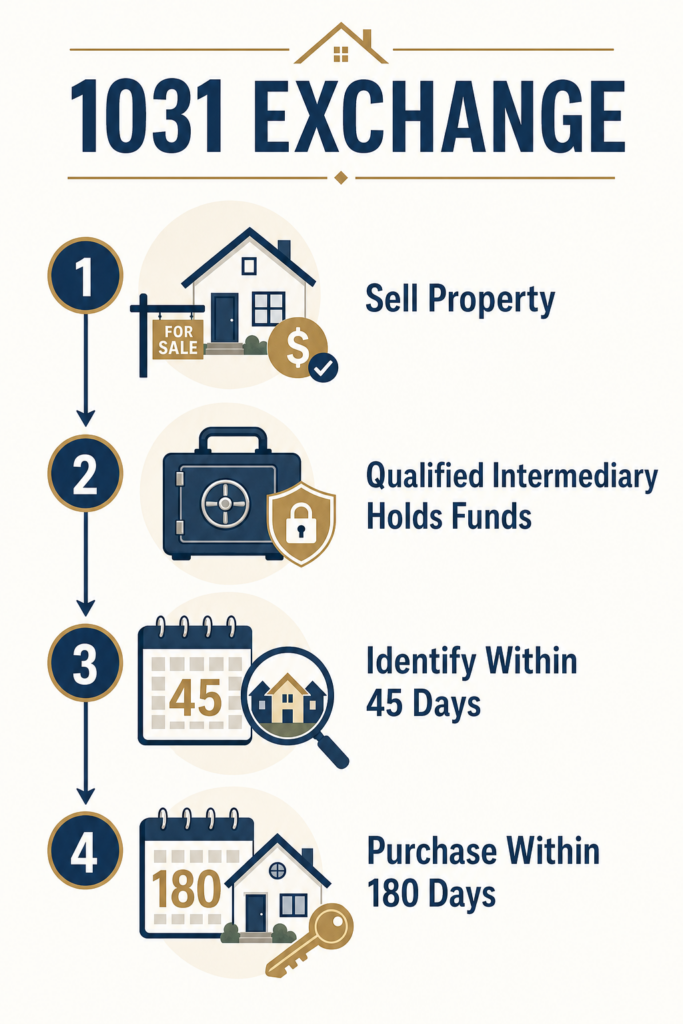
You sell an investment property (known as the relinquished property) and use the proceeds to purchase another qualifying like-kind investment property (known as the replacement property). The transaction must follow strict IRS guidelines and be facilitated by a Qualified Intermediary (QI), who holds the sale proceeds throughout the exchange. At no point can you take possession of the funds yourself.
The phrase “like-kind” is often misunderstood. Fortunately, it doesn’t mean you have to exchange an apartment building for another apartment building or raw land for more raw land. In most cases, nearly any real estate held for investment purposes can be exchanged for another qualifying investment property.
At a high level, a standard 1031 Exchange looks like this:
Taxes Are Deferred—Not Eliminated
This is one of the most important concepts to understand.
A 1031 Exchange doesn’t permanently eliminate your tax bill. Instead, it defers it.
Rather than paying capital gains taxes immediately, your gain is carried forward into the tax basis of the replacement property. In layman’s terms, you’re kicking the tax bill down the road while allowing more of your equity to remain invested and continue working for you.
For many investors, that’s incredibly valuable because it allows them to purchase larger or more profitable properties without first giving up a significant portion of their equity to taxes.
Which Properties Qualify for 1031 Exchange?
Generally speaking, real property held for investment or business purposes may qualify for a 1031 Exchange.
Examples include:
-
- Single-family rental homes
- Duplexes and multifamily properties
- Commercial buildings
- Retail centers
- Self-storage facilities
- Vacant land
- Industrial properties
The key requirement is that both the relinquished property and replacement property are held for investment or business use.
Primary residences do not qualify, and properties held primarily for resale—such as most fix-and-flip projects—generally do not qualify either.
You Must Follow the IRS Timelines
The IRS strictly enforces the deadlines associated with a 1031 Exchange.
Once your relinquished property closes, the clock starts ticking.
Day 1
-
- The sale of your relinquished property closes.
Within 45 Calendar Days
-
- Identify your potential replacement property (or properties) in writing and submit to your Qualified Intermediary.
The IRS provides several identification methods, including the Three-Property Rule, the 200% Rule, and the 95% Rule. The Three-Property Rule is the most commonly used because it offers the greatest flexibility. It allows you to identify up to three potential replacement properties regardless of their value.
Within 180 Calendar Days
-
- Complete the purchase of your replacement property.
The 180-day period begins on the same day your original property closes. Depending on when the exchange occurs during the year, you may need to file a tax extension to preserve the full 180-day exchange period.
How to Fully Defer Your Capital Gains Taxes
To fully defer your capital gains taxes, you generally need to:
-
- Purchase replacement property that is equal to or greater in value than the property you sold.
- Reinvest all of the net proceeds from the sale.
- Replace any mortgage debt with an equal or greater amount of debt, or contribute additional cash to make up the difference.
If you receive cash back from the transaction or purchase a less expensive property, you may create what’s known as “boot.” Boot is generally taxable, meaning you could owe taxes on that portion of the exchange even if the rest of the transaction qualifies for 1031 treatment.
Throughout the process, you’ll want to work closely with your CPA, Qualified Intermediary, and any other professionals involved to ensure every requirement is met.
Why I Like 1031 Exchanges
One of my favorite aspects of a 1031 Exchange is the potential to defer capital gains taxes repeatedly while continuing to grow a real estate portfolio.
Rather than paying taxes after every sale, investors can continue exchanging into larger or more profitable properties, allowing more of their equity to remain invested over time.
Even more appealing is what can happen from an estate planning perspective. Under current tax law, if those investment properties are eventually passed on to your heirs, they generally receive a stepped-up basis. That means the deferred capital gains accumulated during your lifetime may never be recognized by you, leaving your heirs with a significantly more favorable tax position.
Of course, tax laws can change over time, which is why it’s important to work closely with qualified tax and legal professionals when building a long-term investment strategy.
Thanks for reading this week’s Experience, and best of luck in your real estate investing journey!
-BROCK